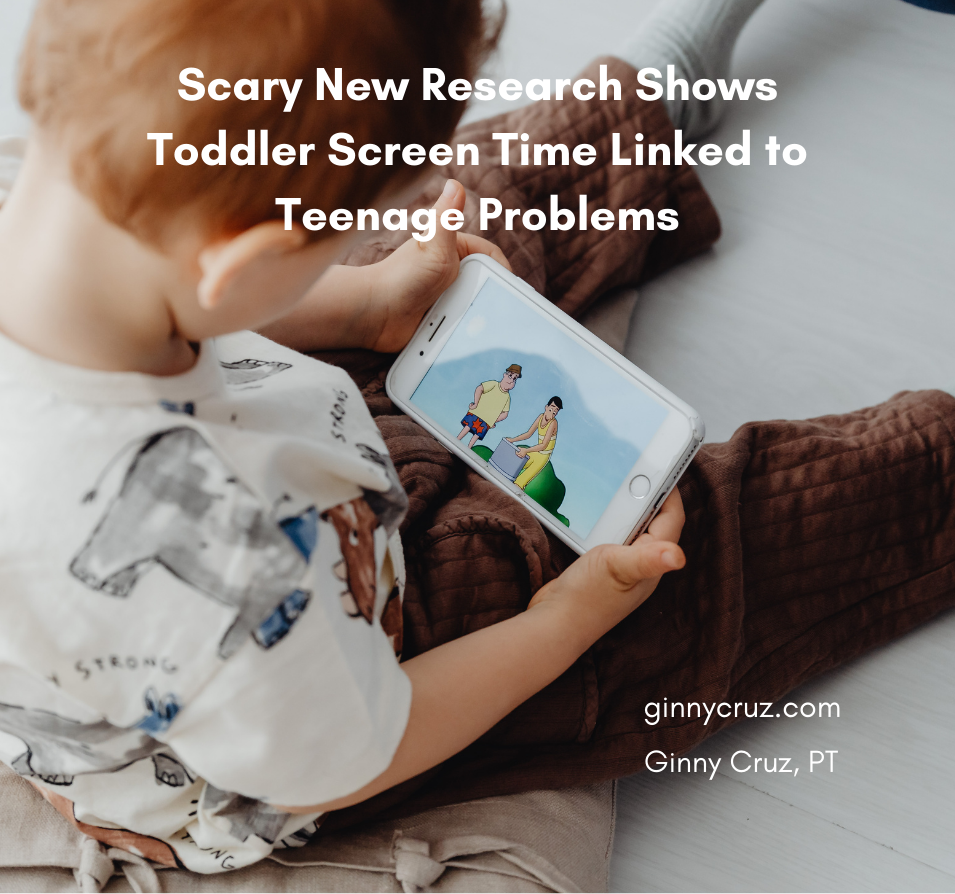
Scary New Research Shows Toddler Screen Time Linked to Teenage Problems
Scary new research reveals long-term problems for toddlers who spend too much time on screens. Scientists in Singapore tracked 168 children for more than a decade, using brain scans at ages four-and-a-half, six, and seven-and-a-half to examine the effects of excessive screen time on children’s brains. What they found was worse than expected—structural changes in their brains, indicating accelerated maturation of networks involved in visual processing and cognitive control.
What is Accelerated Maturation?
You may think, “I want my baby’s brain to mature faster!” That seems like a good thing, right? Not really. When our babies overuse certain parts of their brains and underuse others, the most-used areas form faster pathways (accelerated maturation). Think of it as a superhighway, where information flows quickly.
The problem with a superhighway is that there are limited entry and exit points. A country road, however, has many stop lights, side streets, and slower, more interesting ways to travel from point A to point B. Young children need activities rich in sensory information (smells, movement, touch, etc.), the kind you’d find on the slower route.
When they spend excessive time on a single activity, such as using a handheld tablet, their learning is shallow. Yes, they’re quick to tap the duck’s picture to make him quack or match duck images on a screen, but do they know how to carry the duck to the kitchen and give him a drink? Doing the latter incorporates their bodies and imagination and shows they’re learning to care for another living thing. Playing on tablets doesn’t provide all of those sensory-rich things.
Using the analogy of the superhighway, they’re missing out on exploring quant bookshops on a side street, tasting local barbecue at a food truck, or seeing (and smelling) fields of lavender. A superhighway gets you there fast, but the experience is less rich than those found when you dawdle. Young children need to dawdle and explore. They want to investigate, experiment, and make rich memories along the way.
Accelerated maturation, while it may sound desirable, is not best for young children. Real-world, sensory-rich interactions (the kind found offline) with real people and things are what create well-rounded, experience-rich brains.
What Did the Research Reveal?
When the children turned eight, they took longer to make decisions because they overthought things. By age thirteen, they reported more anxiety. The researchers hypothesize that the accelerated maturation of those cognitive and visual processing pathways eventually led to inflexibility in processing multiple inputs, causing them to become anxious and hesitant to make decisions.
How Can You Use This Information?
Abundant research proves babies and toddlers learn best when playing offline with physical toys and real people. Interacting with people is less predictable than touching buttons or viewing videos on a tablet. Playing with people teaches your baby to deal with unpredictability, which is the way the real world is experienced. Then, when your baby becomes a teenager, they’ll be more confident making decisions based on multiple types of sensory information (visual, touch, smell, etc.).
This latest research unearthed physical evidence (changes in their brain structure) that the children had experienced inadequate play activities (too much screen time) during their formative years. Share on XWhat is not yet known is whether those damaging brain changes (accelerated maturation) can be undone or whether the anxiety and decision-making struggles follow the child into adulthood.
Something to Think About
When our babies are young, it’s hard to imagine them as teenagers. This research revealed that the poor quality of those early learning experiences carried over into the teenage years. In this case, excessive screen time was harmful.
If we want our future teenagers to thrive rather than suffer from social awkwardness or rigid thinking, we must build richer screen-free play activities into their daily routines. I understand it isn’t easy, but our tots need us to make the hard but best choices.
In my latest book, The New Mom’s Guide: Help and Hope for Baby’s First Year, I share over 400 easy activities you can use to teach your baby how to carry that duck to the kitchen and give him a drink, plus every other skill listed as a first-year milestone.
We all know the virtual world isn’t going anywhere. It’ll be there when our babies are older. For now, they’ll do much better dawdling down life’s side roads, experiencing as many sensory-rich activities as possible.
What’s your biggest hurdle to limiting (or eliminating) screen time?
Want more info?
Sign up for my newsletter or join my online baby development support group.
(Photo: Canva)