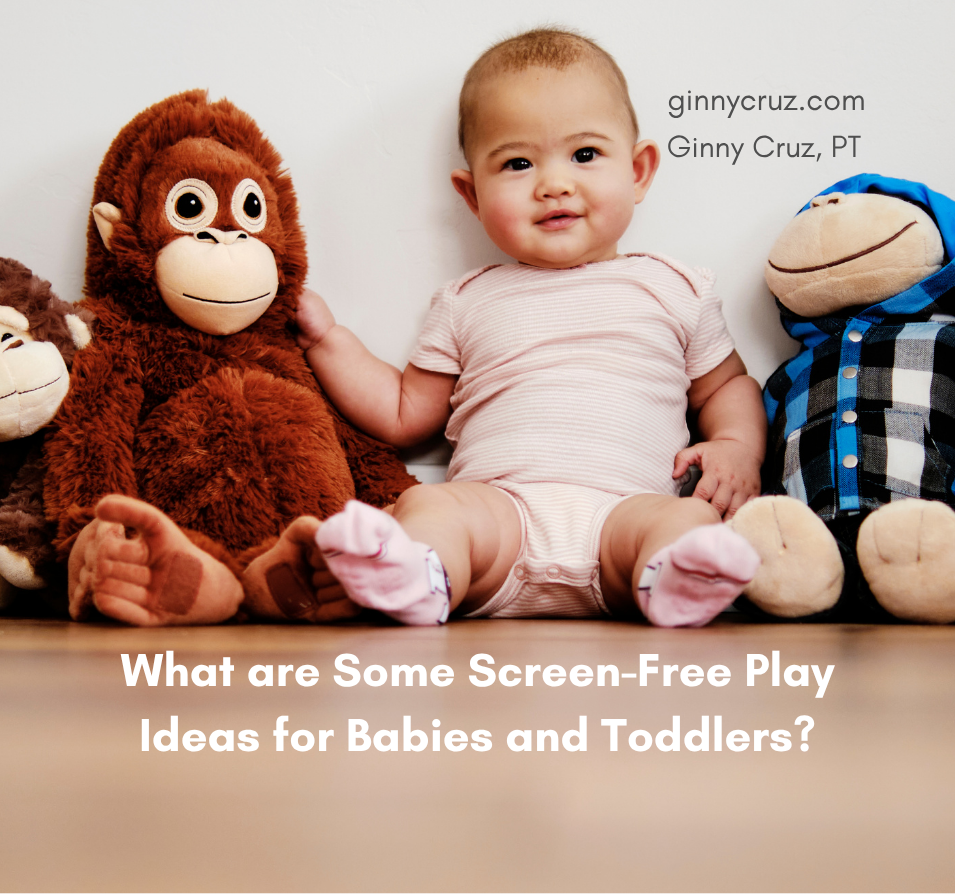
What are Some Screen-Free Play Ideas for Babies and Toddlers?
An increasing number of parents now realize that babies and toddlers need healthier play options than those offered by electronic devices. Yes, screens are easy for parents, especially when we’re busy and tired. Yet the research showing the harms to young brains caused by inadequate offline play activities is now finding its way into daily conversations. And those mom-to-mom discussions often lead to the question: What screen-free play activities are best?
Let me give you some ideas.
Screen-Free Play Ideas for 0-6 Months:
What do babies crave during these early months? They love faces, voices, and gentle movement.
Knowing what they crave helps us decide which play ideas to implement. It also helps when parents understand that babies often crave things they need. They need faces, voices, and gentle movement because what your baby is learning in these first few months is:
- Who are these people in my life?
- What do their voices sound like?
- Can I trust them to take care of my needs?
A few play ideas:
- Face-to-face talking, singing, and exaggerated expressions.
- Tummy time using a baby-safe mirror.
- Soft black-and-white or high contrast cards or books.
- Slow music and rocking.
*You can find a ton more ideas in my latest book, The New Mom’s Guide: Help and Hope for Baby’s First Year.
Tip: They need a few toys and lots of YOU!
Screen-Free Play Ideas for 6-12 Months:
What is your baby craving/needing during the latter half of their first year? Babies adore cause-and-effect toys and activities that offer different types of sensory input (vision, touch, smell, taste, hearing, and movement).
Cause-and-effect toys teach babies how their actions influence their world, plus how to solve problems. For example, to make the bunny pop up, your baby must push a button. Babies also crave sensory input because exploring their senses builds vital nerve pathways in their brains that promote cognitive growth, problem-solving, and memory.
A few play ideas:
- Board books with textures, flaps, and poppers.
- Stacking cups and rings.
- Musical toys (simple, not flashy).
- Peekaboo and Pat-a-Cake.
*You can find a ton more ideas in my latest book, The New Mom’s Guide: Help and Hope for Baby’s First Year.
Tip: Everything is going into their mouths because they’re exploring. Watch them like a hawk!
Screen-Free Play Ideas for 12-18 Months (Toddlers):
Most babies are walking by the first half of their second year, which is why they are called toddlers. The word toddler stems from the word toddle which means to walk with short, unsteady steps.
What do toddlers crave? They are often on the move (whether crawling or walking) and crave movement and the imitation of actions, sounds, and behaviors.
A few play ideas:
- Push/pull toys.
- Chunky puzzles.
- Household items (wooden spoons, plastic bowls, hairbrushes, etc.). Avoid remote controls.
- Songs with motions (“Wheels on the Bus” or “If You’re Happy and You Know It”).
Tip: Toddlers love copying you, so invite them to “help”.
*You can find a ton more ideas in my latest book, The New Mom’s Guide: Help and Hope for Baby’s First Year.
Screen-Free Play Ideas for 18-24 Months (Toddlers):
Older toddlers want independence, and “I do it!” is their preferred command. They also love, love, love repetition. While parents tire of reading the same book a hundred times, it helps us to remember that repetition is how children learn (adults, too).
A few play ideas:
- Simple pretend play (baby doll, toy phone, animals).
- Crayons and blank paper. Scribbling is what they’re working on, not staying inside the lines.
- Ball play (rolling back and forth, kicking, tossing).
- Water play (splashing, dipping, pouring). Use bathtubs, sinks, and water play stations.
Tip: Repetition is not boring; it’s brain-building.
*You can find a ton more ideas in my latest book, The New Mom’s Guide: Help and Hope for Baby’s First Year. While my book focuses on first-year play skills, many of those same activities carry over into toddlerhood, especially if your baby is delayed in meeting some milestones.
A Final, but Important Reframe
Your baby will crave devices (tablets or smartphones), but it is not because they need them. While their desires for other play activities (listed above) stem from the need to learn certain skills, devices are created to addict them to unhealthy activities.
You have not failed as a parent if your baby loves devices; we all love them. Yet our brains are fully formed, and our children’s are not. That is the essential difference. Research shows that the brains of children who spend too much time on screens are not developing normally, leading to developmental delays, behavioral, and academic struggles.
Screens capture our children’s attention so strongly that they become disinterested in real life. Yet the real world (offline) is where they need to play so their brains develop properly. Our babies trust us to do what’s best for them. And playing with screen-free activities, as listed above, is what is best for their brain development. Share on X
Ways to Get Started
Please join the growing movement of parents (and grandparents) ditching screens to give their children a healthy brain and a head start on academic success.
What are the things that are stopping you from implementing a screen-free or screen-lite lifestyle?
Are you looking for an online mom (or grandmom) support group? Join Tummy Time Prayers on Facebook. We’d love to have you.
Please subscribe to my blog and newsletter for more encouragement and development tips for babies and toddlers.
(Photo: Canva)

The Conversation
Your book is a great resource. That’s why I give it to new moms in my neighborhood and friend group. Thank you for the wonderful information.